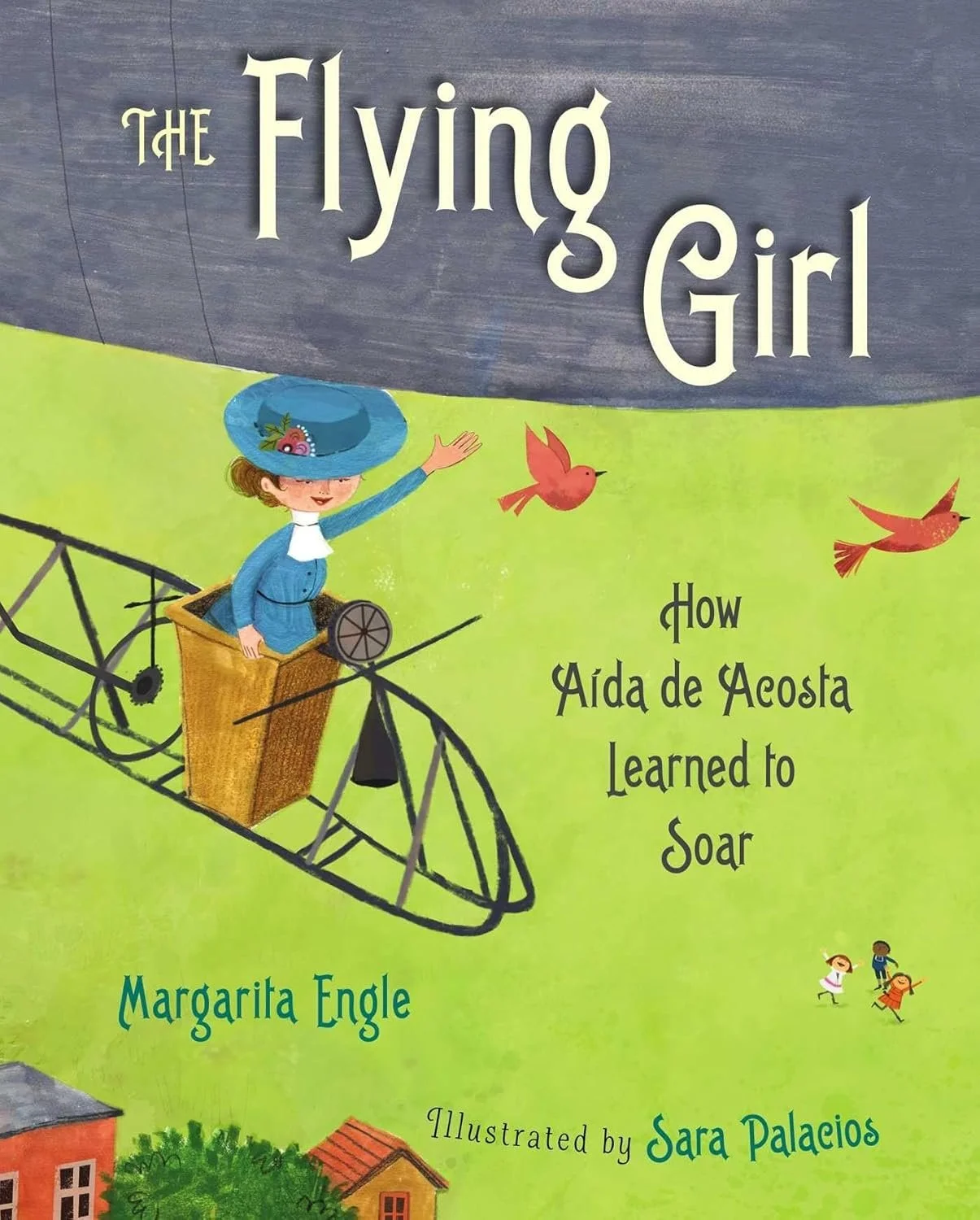
The Flying Girl
Book Summary:
The Flying Girl tells the true story of Aída de Acosta, a young Cuban American woman who became the first woman to pilot a powered aircraft in 1903. Fascinated by flight, Aída secretly learned to control an airship in Paris despite social expectations that discouraged girls from pursuing science and adventure. Her story highlights curiosity, courage, and the pursuit of innovation during the early age of aviation.
Recommended Questions:
What time period does this story take place in? What clues from the text or illustrations help you determine this?
What expectations did society have for girls and women during Aída’s time? How did Aída challenge those expectations? How did Alberto challenge those expectations?
Why was flight considered such an exciting and important new technology in the early 1900s?
Alberto described airships as “chariots of peace.” What do you think he meant by this?
How could air travel help people from different countries better understand one another?
Why do you think the author included the detail that Aída’s clothing made it difficult for her to exit the aircraft?
If you could invent a technology to help bring people together peacefully, what would it be and why?
Imagine you are a journalist living during this time period and have been asked to write a newspaper article about Aída de Acosta’s flight. What details would you include to help readers understand why her achievement was important? What title would you give your article, and why?
NCSS Theme 8: Science, Technology and Society
This book explores how early aviation technology transformed ideas about travel, communication, and human possibility. Aída de Acosta’s experience demonstrates how innovation challenges social expectations, particularly gender roles that limited women’s participation in science and technology. Students examine how technological advances both shape society and are influenced by cultural norms.
Social Justice Anchor Standard 5: Traits of various cultures
This book supports identity development by showing how Aída navigated cultural expectations and gender norms while pursuing her passion for flight. Her story encourages students to reflect on how individuals negotiate identity and challenge stereotypes in different social and cultural spaces.
WA Geography 3: Understands the geographic context of global issues and events
Early aviation reduced geographic barriers and changed how people connected across continents. The book allows students to examine how advances in transportation reshape global relationships and influence movement between regions such as Cuba, Europe, and the United States.
