When the Schools Shut Down
Book Summary:
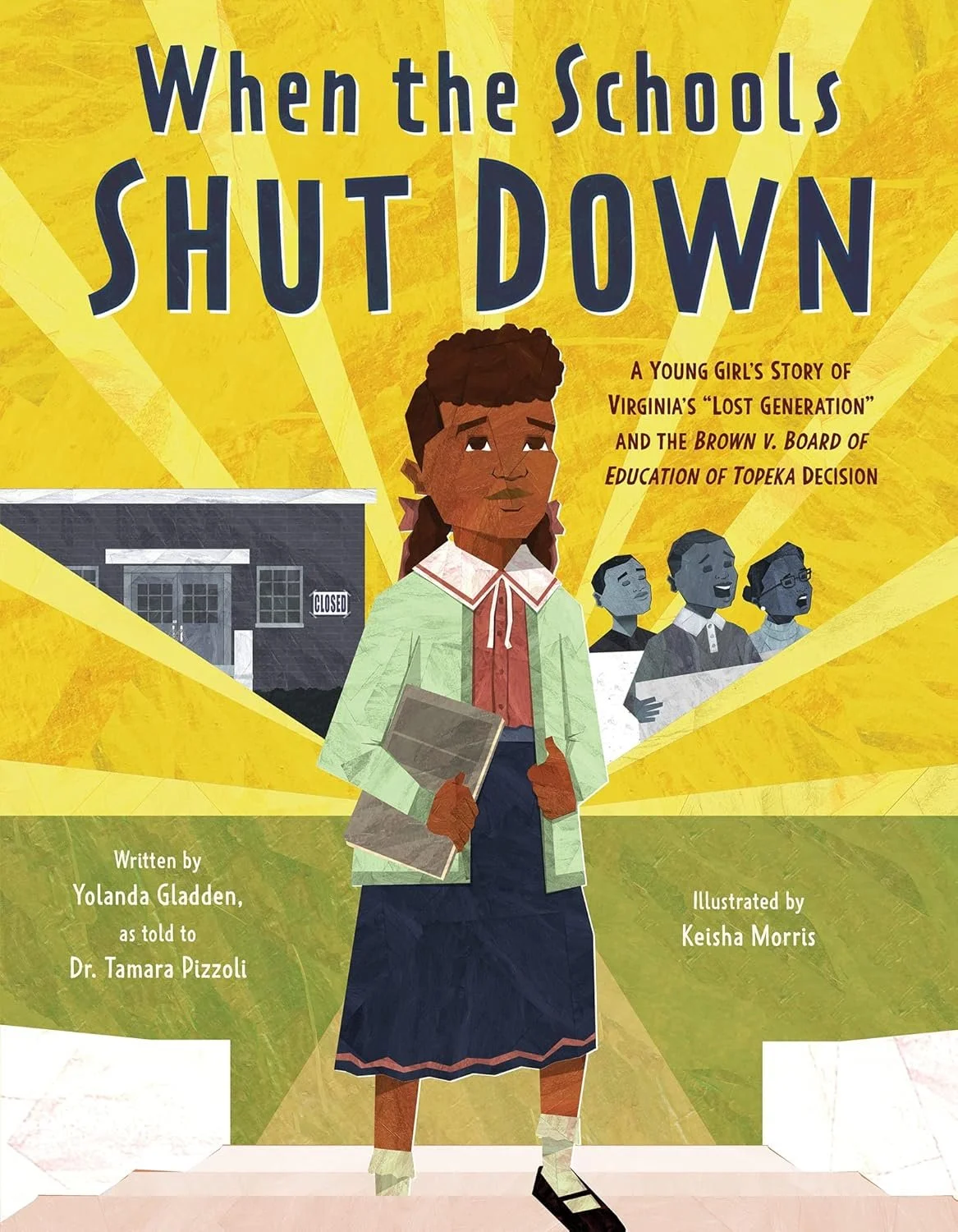
When the Schools Shut Down tells the true story of a young Black girl in Prince Edward County, Virginia, where public schools were closed for five years rather than integrated after Brown v. Board of Education. While white families created private academies, Black children were denied formal education and forced to find learning opportunities elsewhere. The book highlights the long-term impact of these decisions on students, families, and communities.
Recommended Questions:
Choose one of the following quotes from the book and explain why it is significant to the story:
“A child who only learns at school is an uneducated child.” — West African proverb
“The function of education is to teach one to think critically. Intelligence plus character—that is the goal of true education.” — Dr. Martin Luther King Jr.
“If home is where the heart is, school is where the mind thrives.” — Dr. Tamara Pizzoli
In the story, Mrs. Herndon says, “If you know your history, then you’ll know where you’re going.” The illustration on this page includes important historical figures such as Jane C. Wright and Marcus Garvey. Choose one person shown on the page to research. Why is this person important to the history of justice or education?
The book explains that “because a law is legal doesn’t mean it is just, and just because a law exists doesn’t mean everyone will follow it.” How does this statement help you better understand how laws/governance work in the United States?
The story describes different ways people spoke up against injustice—some “hit the pavement” to protest, while others “hit the books” to learn and educate. If you were living during this time period, what form of activism might you have chosen, and why?
Why is access to education considered a civil right?
How can denying education affect individuals, families, and communities over time?
NCSS Theme 6: Power, Authority and Governance
This book connects strongly to Power, Authority, and Governance by showing how government leaders wrongfully used their authority to shut down public schools rather than follow the Supreme Court’s mandate to integrate them. The story illustrates how power can be misused to deny rights and maintain injustice. At the same time, it highlights how communities challenge unjust authority through protest, collective action, and alternative forms of education.
Social Justice Anchor Standard 12: Systemic injustice
The book shows injustice through the denial of education to Black children based on race. It helps students recognize how systemic racism operates through policies and institutions. The story encourages students to think about the responsibility to challenge unfair systems.
WA Civics 2: Understands the purposes, organization, and function of governments, laws and political systems
The story illustrates how state and local governments responded to federal law after Brown v. Board of Education. Students see how laws can be ignored or resisted by those in power, and how government structures affect people’s daily lives. This helps students understand the role of government in protecting—or denying—civil rights.
