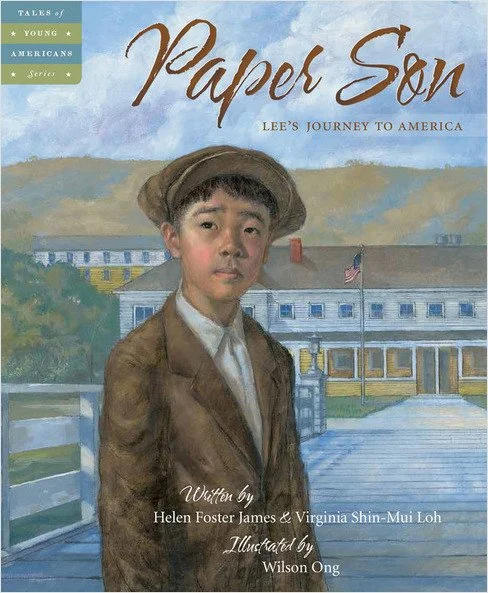
Paper Son
Book Summary:
Paper Son tells the story of a young boy, Lee, who immigrates to the United States at the age of twelve using a “paper son” identity during a time of restrictive immigration laws. He must navigate intense questioning at Angel Island, leaving his family behind in China and confronting fear, uncertainty, and hope for a new life. The book explores themes of resilience, identity, family, and the challenges faced by immigrants both historically and today.
Recommended Questions:
How are immigration stories today similar to those from years ago?
How do these stories help you understand immigration in our country today?
How do you think Lee’s grandparents felt about him immigrating to the United States?
How do you think this story would be told from the interrogator’s point of view?
What feelings might you have if you had to leave your family to immigrate to another country at the age of twelve, as Lee did?
How do you think Lee’s experience at Angel Island shaped his identity and understanding of the U.S.?
Why do you think Lee had to use a “paper son” identity to enter the U.S.?
How does this story help you empathize with people who immigrate under difficult circumstances?
What challenges did Lee face that might be similar to challenges immigrants face today?
Why is it important to learn about individual immigrant stories instead of only general statistics or laws?
Standards:
NCSS Theme 2: Time, Continuity and Change
The story highlights how immigration policies and experiences have evolved over time, showing both change and continuity in the challenges faced by newcomers to the United States. By examining Lee’s story, students can see how history shapes individual experiences and understand how immigration struggles impact communities over generations.
Social Justice Anchor Standard 11: Recognize Unfairness
Paper Son challenges stereotypes about immigrants and the assumptions that underpinned discriminatory laws. By focusing on Lee’s individual experience, students learn to see immigrants as unique people with hopes, fears, and resilience, rather than as anonymous members of a generalized group.
WA History 3: Understand that there are multiple perspectives and interpretations of historical events
Lee’s story serves as a historical account that allows students to analyze primary and secondary sources. By examining his experience, students can evaluate evidence, understand context, and make connections between individual narratives and broader historical events, such as restrictive immigration laws and Angel Island processing.
Links to Related Primary and Secondary Sources
