Fight of the Century
Book Summary:
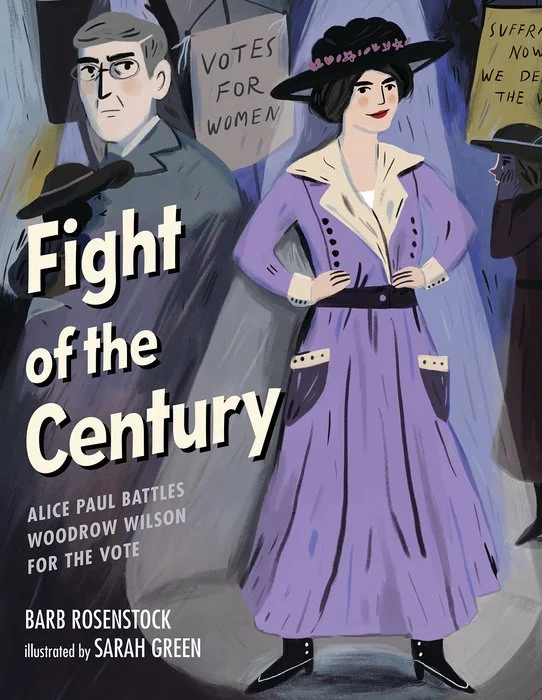
Fight of the Century tells the story of Alice Paul and her fight for women’s right to vote. Barb Rosenstock uses a boxing match as a metaphor for the struggle between Alice Paul and President Woodrow Wilson. Alice and other suffragists organized a large parade, met with the president, created petitions and banners, and protested outside the White House to demand that women be given the right to vote. The book shows that creating change can take time, persistence, and collective action. The suffragists continued protesting even when they faced angry crowds, arrest, imprisonment, and violence. After more than four years of pressure from Alice and other suffragists, Wilson supported the suffrage amendment in 1918. Congress passed the amendment, and after enough states approved it, the 19th Amendment was ratified in 1920.
Recommended Questions:
Why was it important for women to have the right to vote? How is the idea of democracy stronger when women can vote?
Why did Alice Paul organize a large parade in Washington, D.C.? How could a public demonstration help people get the government’s attention?
The suffragists used many different strategies, including marches, petitions, meetings, banners, and picketing. Why might they have used so many different strategies instead of just one?
Why do you think President Wilson did not immediately support women's suffrage? What does his response show about the power government leaders have to influence change?
The suffragists continued protesting even when people opposed them and some were arrested and mistreated. Why do you think they continued? What does this show about civic participation?
The suffragists used President Wilson’s own words about freedom and democracy on their banners. Why might using someone’s own words be an effective way to make an argument?
Alice Paul and other suffragists worked together for many years before the 19th Amendment became law. What does their story show about how change happens? Why might change take a long time?
The book describes Alice Paul and President Wilson as being on opposite sides of a fight, but eventually they worked on the same side to support the suffrage amendment. What does this show about how people can work together to solve a disagreement?
The 19th Amendment changed the law about voting rights. Why can changing a law be an important form of civic change?
The author’s note explains that the fight for women’s voting rights was also connected to racial discrimination and that some suffrage marches were segregated. Why is it important to learn about both the progress made by the suffrage movement and the ways some people were excluded from it?
Note: The timeline at the end of the book, including the photographs, provides additional opportunities for historical analysis.
NCSS Theme 10: Civic Ideals and Practices
Fight of the Century strongly explores how democracy, freedom, voting rights, and civic participation. Alice Paul and the suffragists argued that women should have the right to participate in their government through voting. Their use of marches, petitions, public demonstrations, and other forms of protest shows students that civic participation can take many forms and that people can work together to advocate for changes they believe are important.
Social Justice Anchor Standard 20: Collective Action
Fight of the Century shows how people can work together to create change. Alice Paul organized with other suffragists who marched, petitioned, demonstrated, and continued their efforts even when they faced arrest and mistreatment. Their collective action helped bring national attention to women's suffrage and contributed to the eventual ratification of the 19th Amendment.
WA Civics 4: Civic Involvement
Fight of the Century shows how individuals and groups can participate in civic life to influence government and create change. Alice Paul and other suffragists organized a large parade, met with government leaders, gathered petitions, demonstrated outside the White House, and continued advocating for a constitutional amendment. Their actions demonstrate that civic involvement can include organizing, protesting, speaking to elected officials, and working with others to bring attention to an issue.
Links to Related Primary and Secondary Resources
Library of Congress Sources #1
