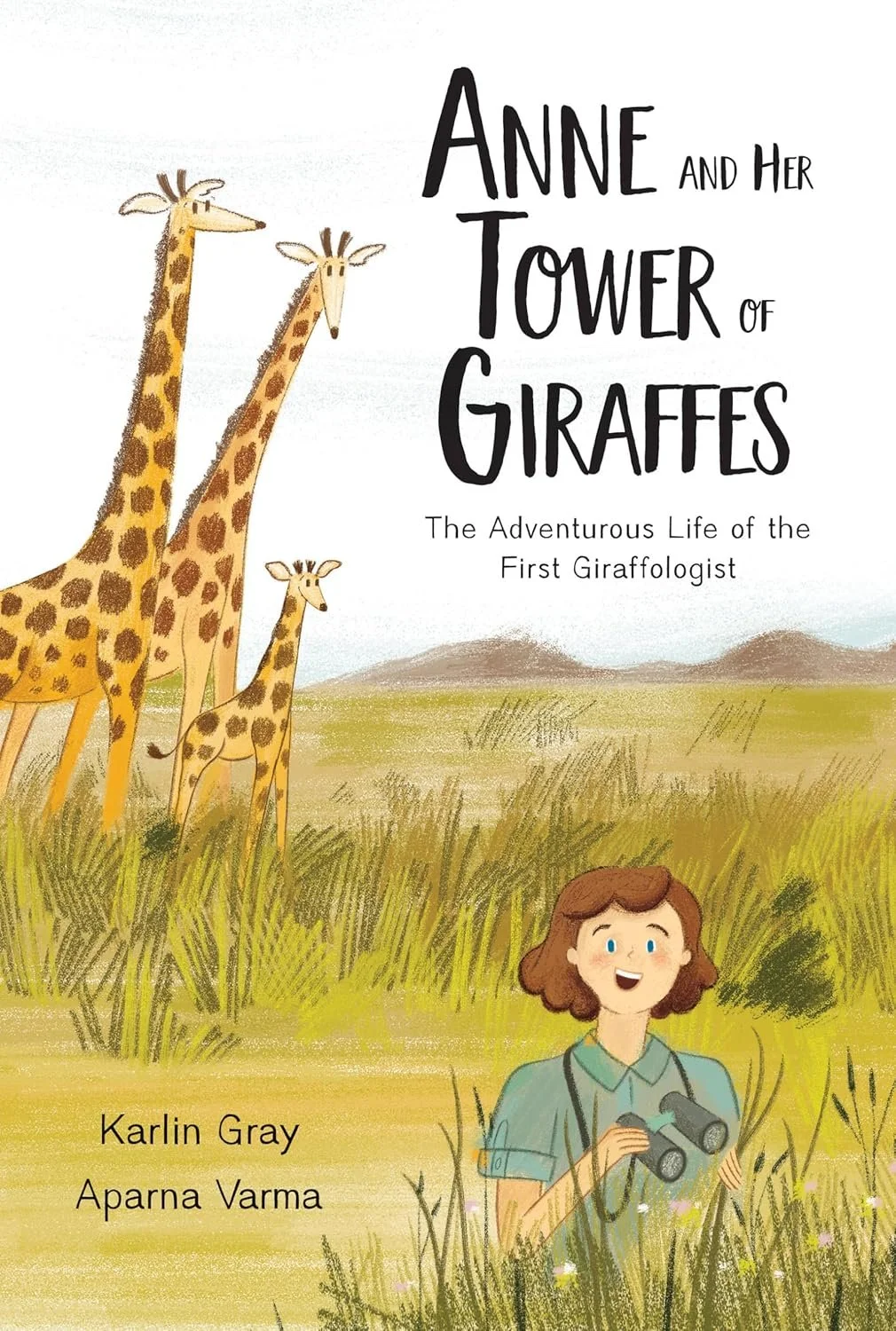
Anne and Her Tower of Giraffes
Book Summary:
Anne and Her Tower of Giraffes tells the inspiring true story of Dr. Anne Innis Dagg, who overcame significant gender barriers to become the world's first "giraffologist" and one of the first scientists to study wild animal behavior in Africa. Driven by a lifelong fascination with giraffes that began when she was just three years old, Anne traveled alone to South Africa in 1956 to conduct groundbreaking research at a time when few women were welcomed in the field of science. Despite facing discrimination and rejection from universities, she persevered, using her writing and research to share her discoveries and leave a lasting impact on STEM, wildlife science, and opportunities for future generations of women scientists.
Recommended Questions:
Why did Anne continue pursuing her research even when others discouraged her or denied her opportunities?
Why was the Fleur de Lys Ranch in South Africa the ideal place for Anne's research? What could she learn by observing giraffes in the wild that she could not learn from studying them in a zoo?
How did gender stereotypes and social expectations affect Anne's opportunities as a scientist?
Anne was denied tenure because of her gender. Why is this considered an institutional barrier, and how is it different from prejudice or discrimination by a single individual?
Why is it important to challenge assumptions about who can be a scientist, researcher, or leader?
Jane Goodall is often recognized as a pioneer for studying animals in the wild, yet Anne Innis Dagg began her field research on giraffes four years earlier. Why do you think some scientists become household names while others receive less recognition? What factors influence whose contributions are remembered in history?
The author's note explains that a university formally apologized in 2018 for denying Anne tenure decades earlier. Why might institutions revisit and acknowledge past mistakes? What can be gained from doing so?
Anne conducted her research in South Africa during apartheid. How did she demonstrate the courage to question an unjust system even when she was not personally targeted by it?
Anne's research helped people better understand giraffes and their needs. How can scientific knowledge influence the way humans interact with and protect the natural environment?
The author's note explains that giraffe populations have declined and are now considered vulnerable to extinction. Why should people care about protecting species that live far from where they live?
NCSS Theme 3: People, Places and Environments
Anne and Her Tower of Giraffes explores the relationship between people, animals, and the environments in which they live. Anne Innis Dagg traveled from Canada to South Africa to study giraffes in their natural habitat, learning how geography, climate, and ecosystems influence animal behavior. The book helps students understand how place and environment shape both scientific discovery and the lives of people and wildlife.
Social Justice Anchor Standard 17: Stand up to injustice
Anne and Her Tower of Giraffes demonstrates how individuals can challenge unfair barriers and create change through persistence and action. When Anne Innis Dagg faced discrimination because she was a woman, she refused to give up on her passion for science. Instead, she continued her research, shared her discoveries through writing, and helped open opportunities for future generations of women in STEM. The book encourages students to consider how they can respond when they encounter unfairness and how perseverance can help create a more equitable world.
WA History 4: Historical events inform analysis of contemporary issues and events
This book explores how Anne Innis Dagg's experiences were shaped by the social attitudes and institutional barriers of the 1950s and 1960s. The book helps students understand that history is composed of multiple perspectives and that access to opportunities has not always been equal for all people. By exploring why Anne's groundbreaking research was often overlooked despite its significance, students can analyze how societal beliefs and power structures influence whose contributions are recognized, valued, and preserved in history.
Links to Related Primary and Secondary Resources
