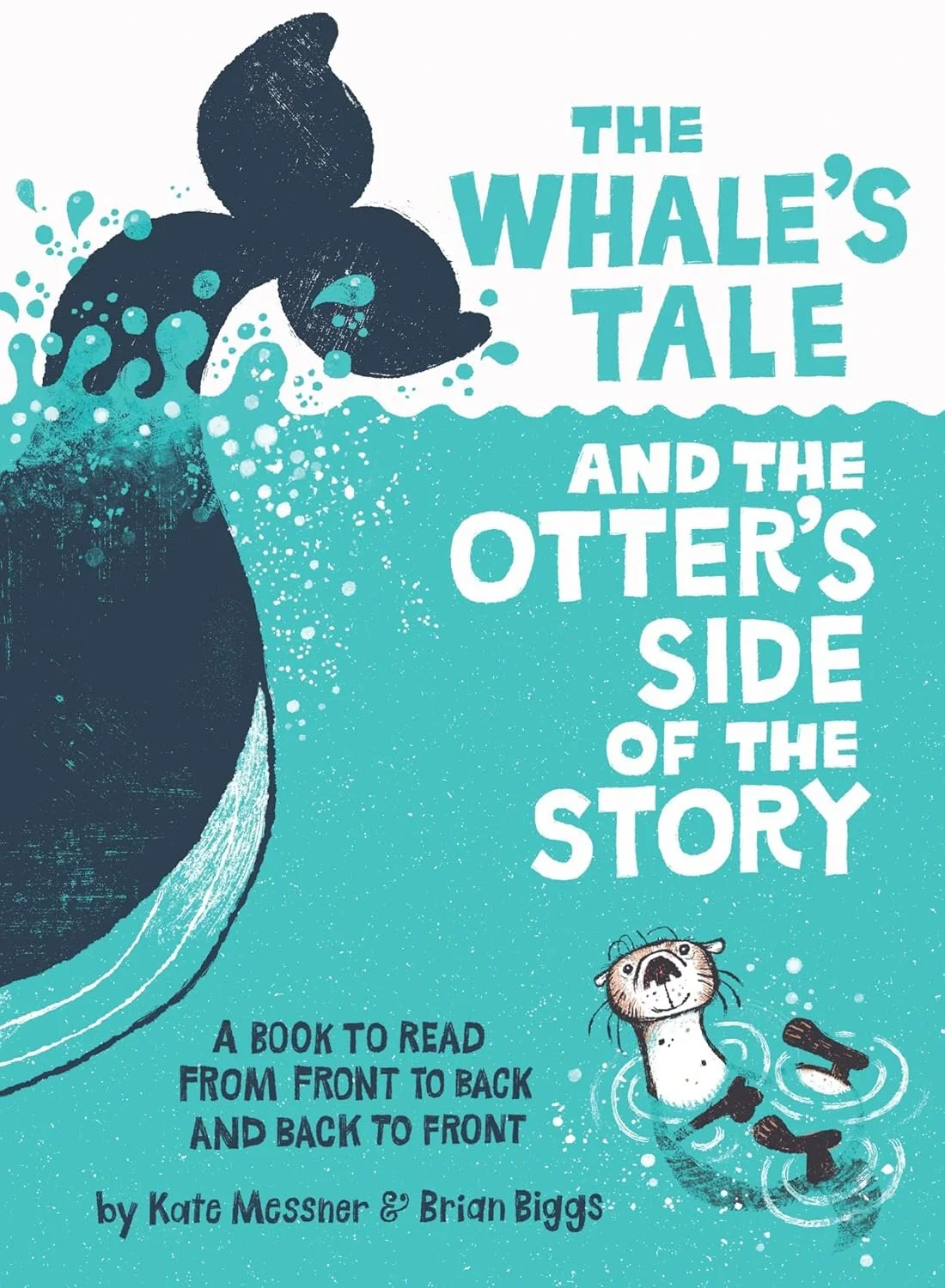
The Whales Tale and the Otters Side of the Story
Book Summary:
The book is designed to be read in two directions. Read from front-to-back, a boastful whale uses various facts to argue why whales are the superior sea creature. When read from back-to-front, an opinionated otter uses those same facts to prove that otters are actually the greatest. It serves as a humorous lesson on how identical information can be framed to support opposing viewpoints depending on a person's perspective. The book includes a note from the author on evaluating bias.
Recommended Questions:
Is it possible for both the whale and the otter to be right at the same time? Why or why not?
Can you find a moment in the book where a character uses a real scientific fact but adds their own opinion or interpretation? How does that change the message?
What evidence suggests that each narrator may be biased?
How does each narrator's bias influence the claims they make and the evidence they choose to emphasize?
The author writes that words can "offer answers, provoke anger, spark inspiration, convey information—or spread lies." Can you find examples of each in the book?
How does understanding a speaker's or author's point of view help us become better readers, researchers, and thinkers?
How can bias affect the way people tell stories, report news, or share information?
How can considering multiple perspectives help us become more respectful, empathetic, and informed members of a community?
What advice would you give the whale? What advice would you give the otter? What advice would you give the audience listening to both sides of the story?
After reading both perspectives, what do you think is the author's most important message?
NCSS Theme 4: Individual Development and Identity
The Whale’s Tale and the Otter’s Side of the Story uses humor and contrasting perspectives to show how individuals can interpret the same events in very different ways. As the whale and otter each tell their own version of the story, readers are encouraged to consider how personal experiences, beliefs, and viewpoints shape identity and influence how people understand the world around them. The book helps students reflect on their own perspectives while developing empathy and an appreciation for the experiences and viewpoints of others.
Social Justice Anchor Standard 8: Respectful curiosity of others
The book’s unique structure—where the story changes depending on which direction it is read—creates a literal exercise in perspective-taking and open-mindedness. As the whale and otter use many of the same facts to argue for their own importance and superiority, readers discover that a single point of view is often incomplete. The story encourages students to listen to “the other side” of a story, recognize the value and contributions of others, and develop a more accurate, respectful, and empathetic understanding of different perspectives and experiences.
WA Social Studies Skills 4: Support claims and present products through meaningful communication
The Whale’s Tale and the Otter’s Side of the Story encourages students to evaluate evidence, compare competing claims, and recognize that the same facts can be interpreted in different ways. As readers analyze the arguments presented by the whale and the otter, they must determine which evidence is strongest and consider how perspective influences conclusions. The book provides an excellent opportunity for students to develop and defend their own claims using evidence from the text while communicating their reasoning through discussion, writing, or presentation.
