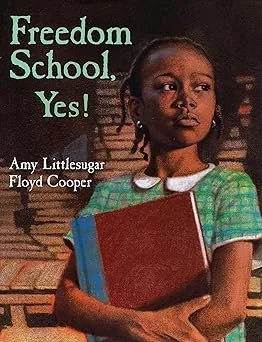
Freedom School, Yes!
Book Summary:
Freedom School, Yes! tells the story of a young African American boy in 1964 Mississippi who attends a Freedom School during the Civil Rights Movement. Through education, community support, and courage, the school becomes a space for empowerment, learning, and resistance against segregation and inequality. The book highlights how education can be a powerful tool for freedom and social change.
Recommended Questions:
What was happening in Mississippi and across the United States during the time this story takes place?
Uncle Shad says, “This here Freedom School ain’t gonna be like no ordinary school. You gonna learn ’bout people and places—’bout who you are. Once you learn that, you ain’t gonna let bein’ scared get in your way.” What evidence from the story shows how the Freedom School is different from an ordinary school?
How does the main character feel about attending the Freedom School at the beginning of the story? Why do these feelings change over time?
Why were regular schools not safe, fair, or equal places for Black children during this period?
How did the Freedom School challenge unfair systems, rules, and expectations?
Why do you think education was viewed as a threat by those in power?
In what ways did attending the Freedom School help students become active, informed citizens?
What risks did teachers, families, and students take to create and attend Freedom Schools?
Why is education an essential part of freedom and democracy?
Research Freedom Schools today. What roles do they play in their communities? How are they similar to or different from regular schools, and why are they still important?
NCSS Theme 6: Power, Governance and Authority
This book shows how laws and local power structures were used to deny Black Americans equal education and political voice. Freedom Schools emerged as a response to unjust authority, creating alternative spaces for learning and civic engagement. The story helps students understand how communities challenge oppressive systems and work toward democratic change.
Social Justice Anchor Standard 17: Stand up to exclusion, prejudice and injustice
This book shows how children, families, and teachers took responsibility for confronting educational injustice by creating Freedom Schools when segregated systems denied Black students equitable learning opportunities. The story emphasizes that standing up to injustice can take the form of learning, teaching, and building community, even in the face of risk. It helps students understand that ordinary people—including young people—have a responsibility to respond to unfairness rather than accept it.
WA Civics 4: Understands civic involvement
Freedom School, Yes! illustrates civic involvement through community organizing, education, and collective action. The Freedom Schools were designed to empower young people with knowledge about their rights and responsibilities. Students learn that civic participation includes learning, teaching, organizing, and building community power
