Ocean Speaks
Book Summary:
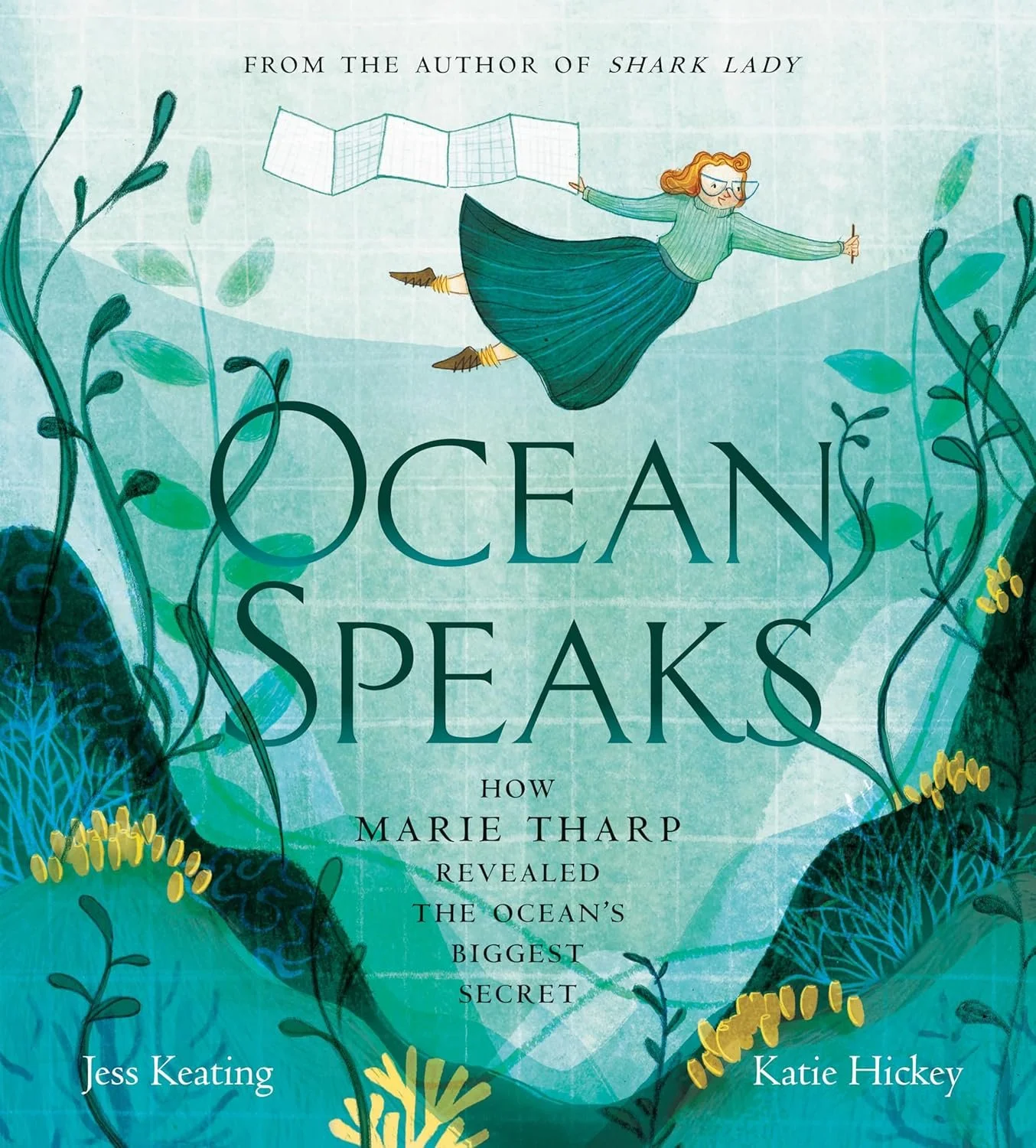
This picture book tells the story of Marie Tharp, the scientist who mapped the ocean floor and helped prove the theory of plate tectonics. Through careful analysis of sonar data, she identified the Mid-Atlantic Ridge and a rift valley running along it—evidence that continents move. Despite facing gender discrimination in a male-dominated field, Tharp’s persistence transformed scientific understanding of the Earth.
Recommended Questions:
How did Marie Tharp’s father nurture her curiosity despite societal expectations about women’s roles? Why do you think he did this?
Which war might the book be referring to? What context clues help you determine this?
Why were women encouraged to study science when men went to war? What happened to many of their jobs when the men returned?
What evidence did Marie Tharp use to support her claim about the ocean floor?
Why were her findings initially dismissed or questioned? Whose scientific work tends to be accepted more quickly? Why?
How does this story show that science is influenced by social context?
Why is it important to study regions that are not visible or easily accessible?
Imagine you are Jacques Cousteau. You initially set out to prove Marie Tharp wrong but instead discover evidence that she was correct. What would be an appropriate response to her and to the scientific community when you return? What responsibilities do scientists have when new evidence challenges their assumptions?
NCSS Theme 8: Science, Technology and Society
The book shows how scientific discoveries can reshape global understanding and influence society. Students examine how new evidence challenged long-held beliefs about the Earth. The story also highlights how social norms—such as gender discrimination—can affect who participates in scientific work. Through Marie Tharp’s experience, students see that science is not only about data and discovery, but also about equity, access, and the social context in which knowledge is produced and recognized.
Social Justice Anchor Standard 14: Influence of power and privilege
Marie Tharp’s experience demonstrates how institutional bias limited whose knowledge was considered credible. Students explore how gender discrimination affected recognition of her work and consider why equitable access and representation strengthen scientific inquiry.
WA Geography1: Understands physical characteristics and location of places regions and spatial patterns
Through Marie Tharp’s work identifying the Mid-Atlantic Ridge and rift valley, students learn how spatial patterns beneath the ocean’s surface reveal important information about Earth’s structure. The book supports geographic thinking by helping students understand how location, physical features, and mapping technologies shape our knowledge of regions—even those we cannot see directly.
