Dancing Hands
Book Summary:
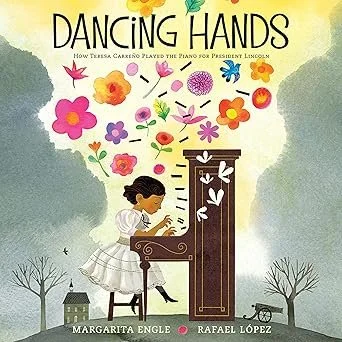
Teresa Carreño was a gifted young pianist whose family fled political unrest in Venezuela and immigrated to the United States. After arriving during the Civil War, Teresa used her music to bring comfort and hope to others, eventually performing for President Abraham Lincoln at the White House. The story highlights resilience, immigration, and the power of music to connect people during difficult times.
Recommended Questions:
How does Teresa’s story show connections between events happening in different countries at the same time?
In what ways did music help connect people across cultures and nations?
How can art, music, and culture create understanding between people from different backgrounds?
What parts of her culture and identity do you think Teresa carried with her after leaving Venezuela?
How does Teresa’s story help us understand the Civil War from a different perspective than soldiers or political leaders?
Why is it important to study history through the experiences of children, immigrants, and artists?
How did unrest in both Venezuela and the United States shape Teresa’s experiences and opportunities?
NCSS Theme 9: Global Connections
The story highlights global connections through Teresa Carreño’s journey from Venezuela to the United States during periods of unrest in both countries. Her family fled political instability in Venezuela, only to arrive in the U.S. during the Civil War, showing how conflict and uncertainty can affect people across the world. Teresa’s music became a bridge between cultures, demonstrating how art and human connection can provide comfort even during times of division and upheaval.
Social Justice Anchor Standard 10: Diversity in social, cultural, political and historical contexts
As a young Venezuelan immigrant, Teresa Carreño navigated life between her home culture and a new culture in the United States during the Civil War. Through music, she maintained connections to her identity while also building relationships in a new environment. The story helps students consider how people adapt to different cultural spaces while preserving important parts of who they are.
WA History 3: Multiple Perspectives
Students can examine the Civil War era through the perspective of a young immigrant musician rather than through battles or political leaders alone. Teresa’s experiences help broaden understanding of how children, immigrants, and artists experienced historical events differently.
